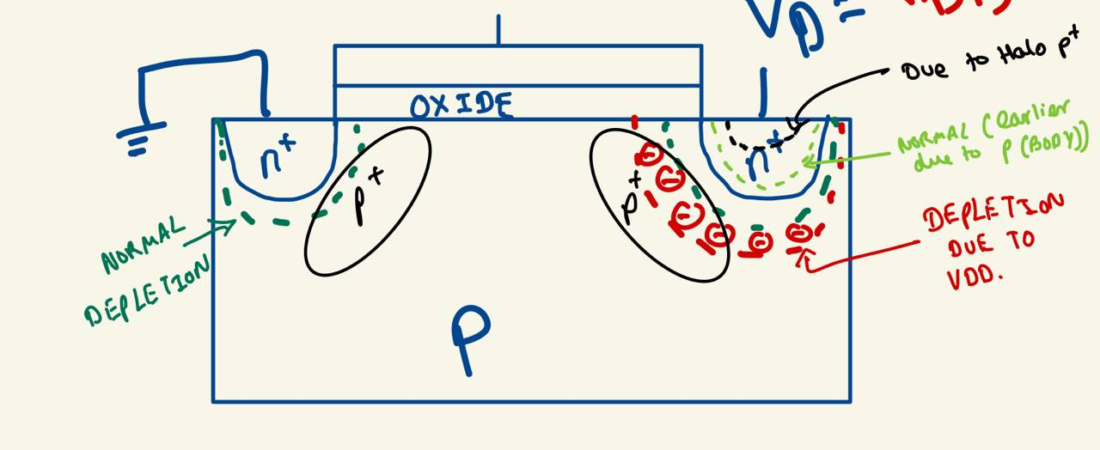
Now we’ll move towards the next important Short Channel Effect, which is DIBL called Drain Induced Barrier Lowering.
What Happens as Channel Length Reduces?
As we bring Drain and Source closer, the channel length reduces, due to which the Drain starts having more influence over the channel and this can reduce the Vt. (Click here to understand more based on CLM)
What Happens When Drain Voltage Increases?
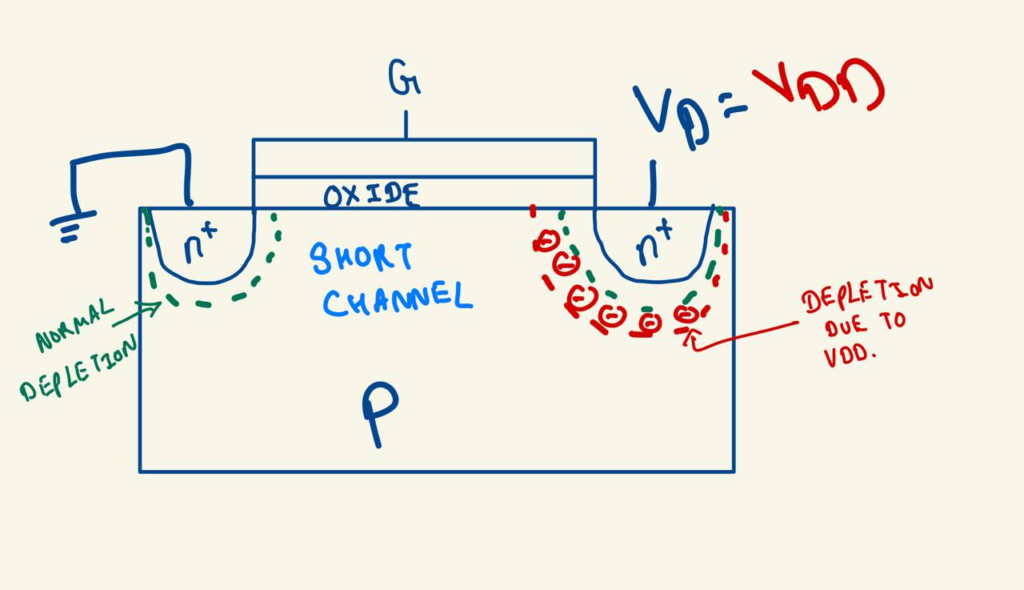
Now, the Drain has a higher potential, and the Source has a lower potential. As we go towards VDD on the Drain side, its depletion region will move inwards into the channel. Along with this, the higher Drain voltage starts influencing the Source-Channel potential barrier.
It lowers this barrier, making it easier for electrons from the Source to enter the channel. This means the Gate now requires less voltage to create the channel, effectively reducing the Vt.
Vd increases –> Source-Channel Barrier decreases –> Vt decreases.
This makes the Vt more dependent on the Drain voltage, which we do not want.
How Do We Control DIBL?
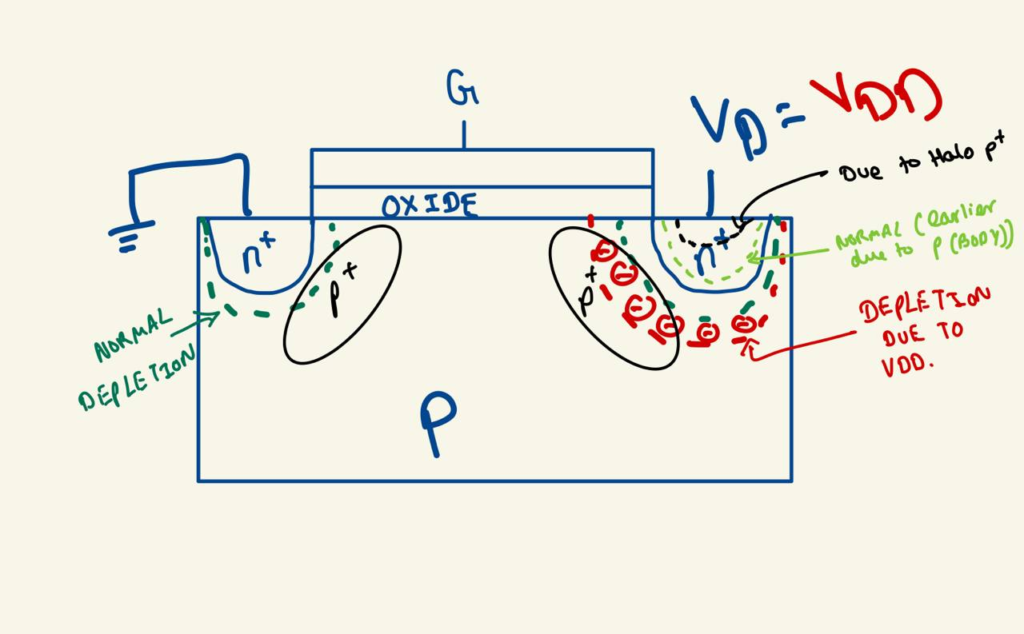
So, we add P+ Halo Implant near the channel on both Source and Drain sides. Both sides because the Source and Drain of a MOSFET can effectively interchange their roles depending on the applied voltages.
The P+ Halo helps to control the Vt because it increases the P-type doping near the Source and Drain. Due to this higher P-type doping, the depletion region is restricted from spreading too much inside the channel, effectively reducing the influence of the N+ Drain and Source regions on the channel.
Thus, the P+ Halo Implant helps reduce DIBL and control Vt.
What Is the Side Effect of Halo Implant?
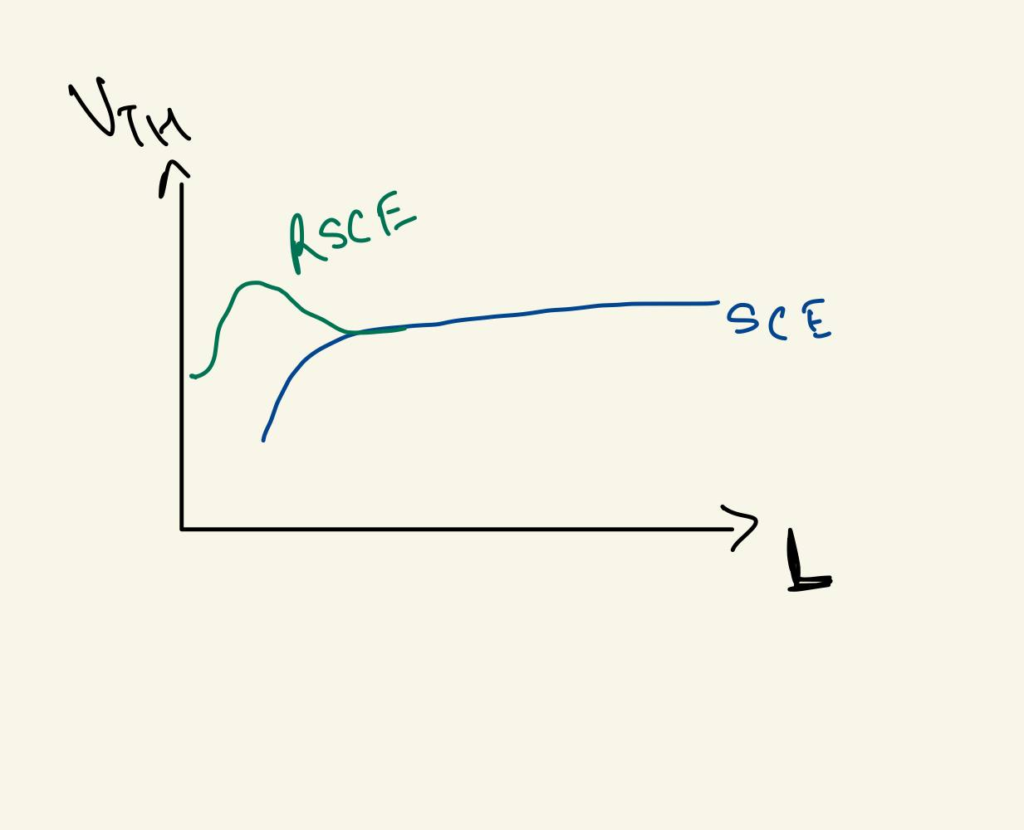
It also induces RSCE (Reverse Short Channel Effect), where initially, due to the additional P+ doping near the channel, the Vt increases as the channel length reduces.
This is opposite to the normal Short Channel Effect where Vt tends to decrease with decreasing channel length. That’s why it is called Reverse Short Channel Effect.
Why Is Vt Reduction and Unpredictability a Problem?
Because it will make the MOSFET harder to control and will also affect the OFF current.
Vt reduces –> I off increases.
So, lower Vt results in higher leakage current and higher leakage power.
Interview Questions
- What is DIBL and why does it occur?
- Why is DIBL more prominent in short-channel devices?
- What happens to Vt when the Drain voltage increases due to DIBL?
- Why is the reduction in Vt due to DIBL a problem?
- How can we reduce DIBL?
- Why do we use Halo Implant to control DIBL?
- Why is Halo Implant provided on both Source and Drain sides?
- Why do we use a P+ Halo Implant for NMOS?
- What is RSCE (Reverse Short Channel Effect), and how is it related to Halo Implant?
- What is the difference between DIBL and Channel Length Modulation (CLM)?
Thanks for reading.
For Feedback and more updates, join this Telegram channel: https://t.me/thesiliconpath
- For previous blogs :
- Go to this link: click here
Also you can subscribe from below for future notifications with your email.