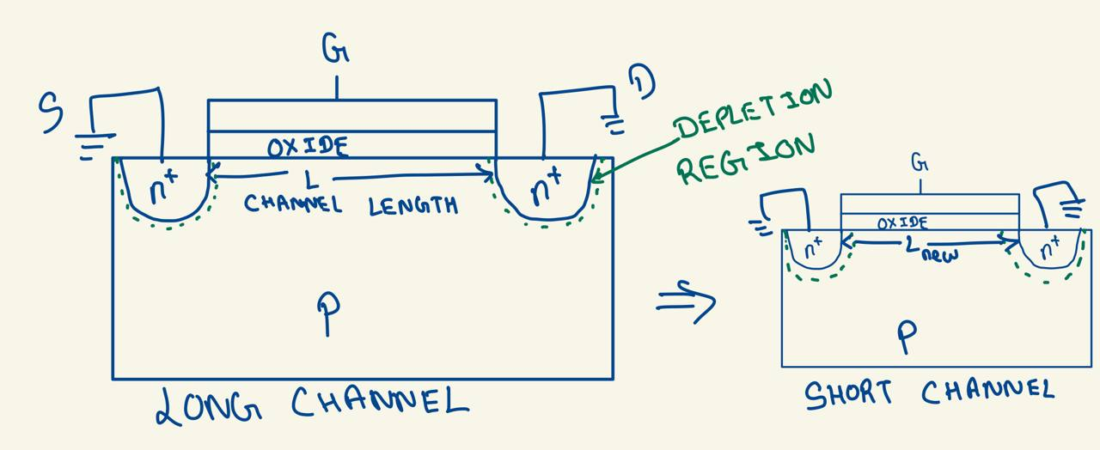
Now we will move towards a very interesting topic called CLM – Channel Length Modulation.
In this, we will bring the Drain and Source closer. In older tech nodes (long channel), we used to ignore the effect of the depletion region because the channel length was long. But in short-channel devices, the channel is so short that the depletion region also starts playing a significant role in the effective channel length.
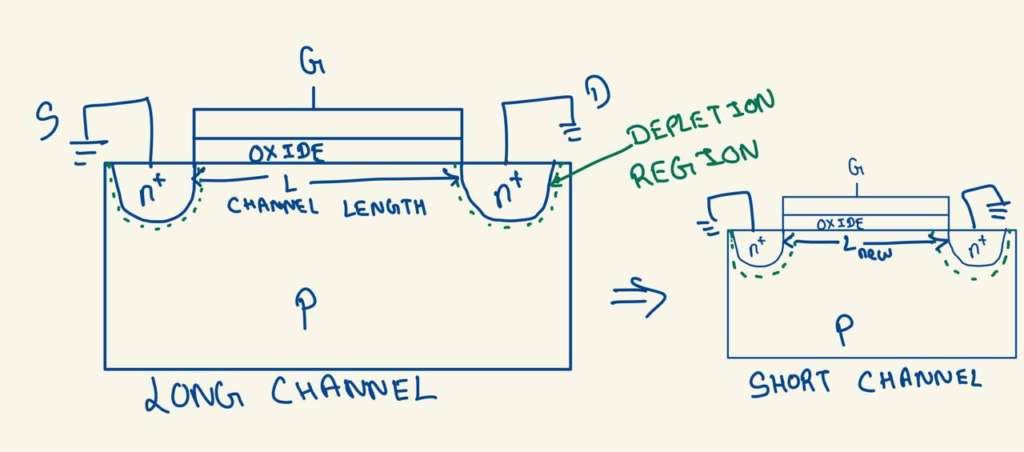
Now, the effective channel length reduction can be understood due to 2 things:
1. Reduced channel length
The channel length itself is reduced by bringing the Drain and Source closer together as we move towards smaller technology nodes.
2. Depletion region
Due to heavily doped n+ Drain and Source regions along with the comparatively lightly doped p type body, depletion regions are formed at the Source-Body and Drain-Body junctions.
The depletion region expands more into the lightly doped p region. This depletion region also extends towards the channel region.
Now, its effect can be understood in 2 cases:
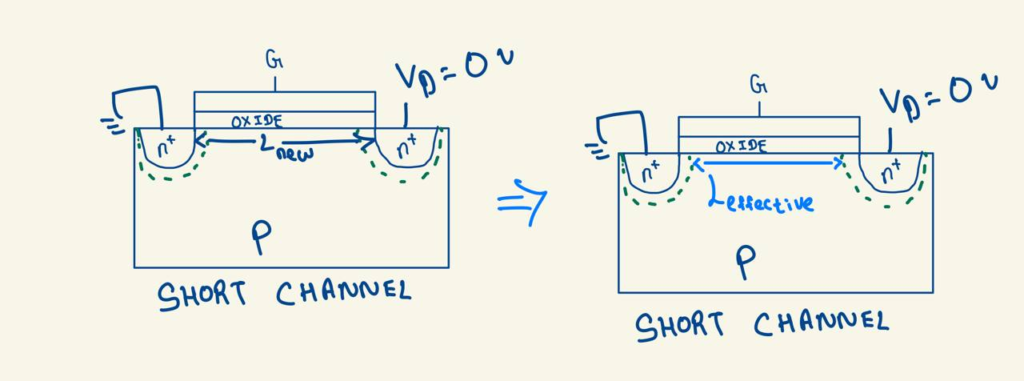
A. When VD = 0
The Drain-Body depletion region is still present because of the built-in potential of the PN junction, but its effect on the effective channel length is relatively small.
B. When VD increases towards VDD
As VD increases, the Drain-Body junction becomes more reverse biased.
This causes the Drain-side depletion region to expand/spread more towards the channel, causing it to take away more part of the effective channel.
So,
VD ↑ → Drain depletion region ↑ → Effective channel length ↓
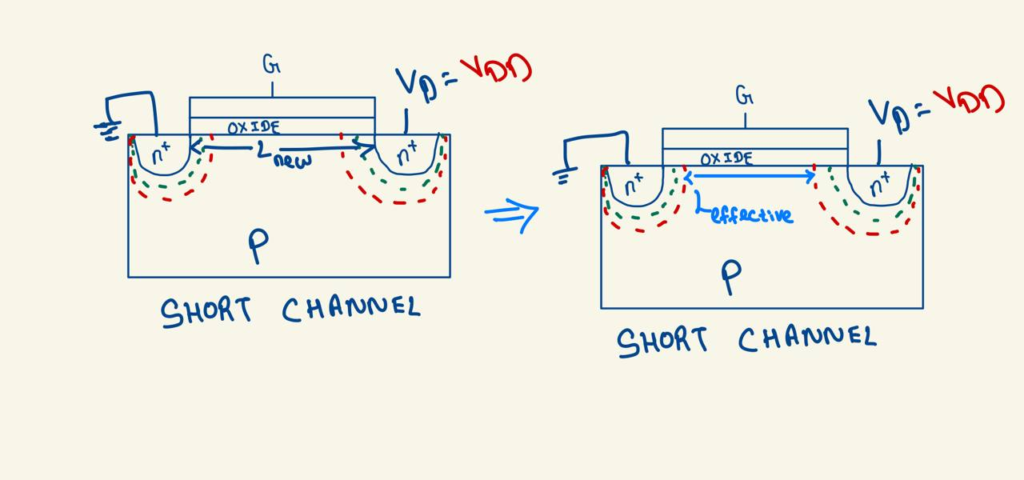
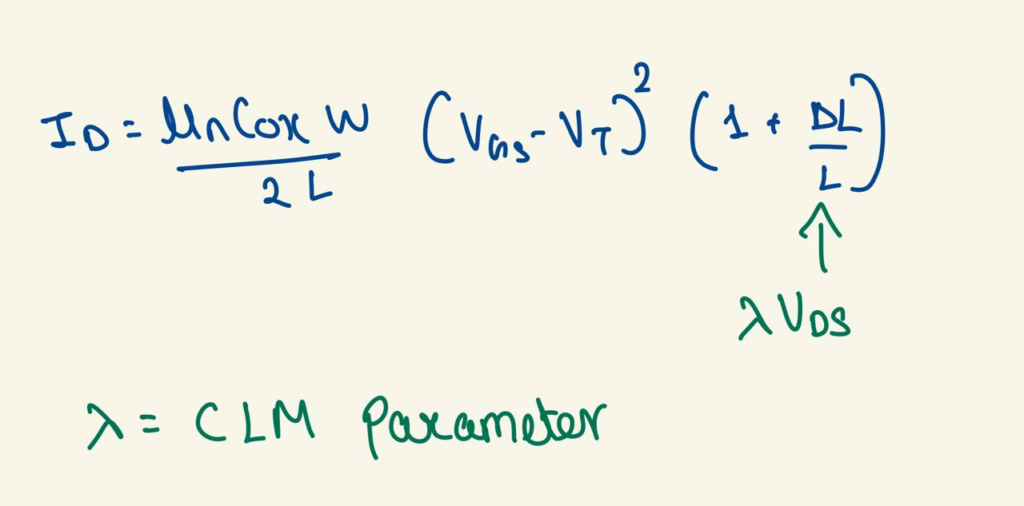
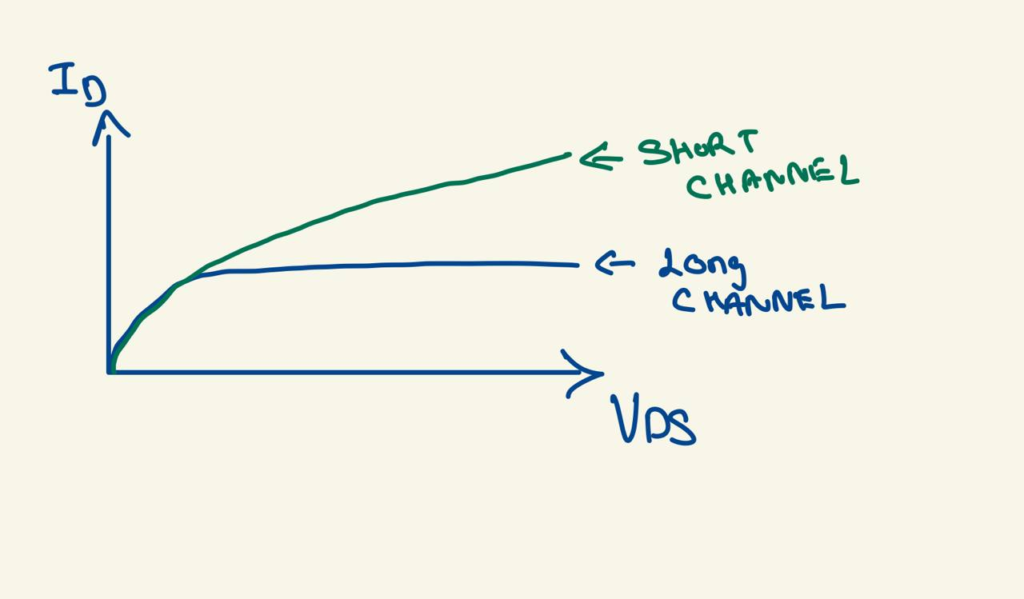
Once the device is in saturation, this reduction in effective channel length with increasing VD (or VDS) is what we call Channel Length Modulation (CLM).
So, one important thing to remember is:
Simply bringing Drain and Source closer is technology scaling, not CLM.
CLM happens when increasing VDS causes the Drain-side depletion region to expand further, reducing the effective channel length.
The term of CLM added in Drain current :
Graph of short channel vs long channel due to CLM :
Thanks for reading.
For Feedback and more updates, join this Telegram channel: https://t.me/thesiliconpath
- For previous blogs :
- VLSI Basics: Body Biasing Interview Questions Explained: click here
- Drain Current Made Simple: Essential VLSI Interview Questions You Must Know: click here
- MOSFET Made Simple: Working, Depletion, Inversion & Interview Questions: click here